A live miracle
Copyright
© 2026 Giovanni Gaetani.
Artwork: Si Nipannan.
All rights reserved.
Intro
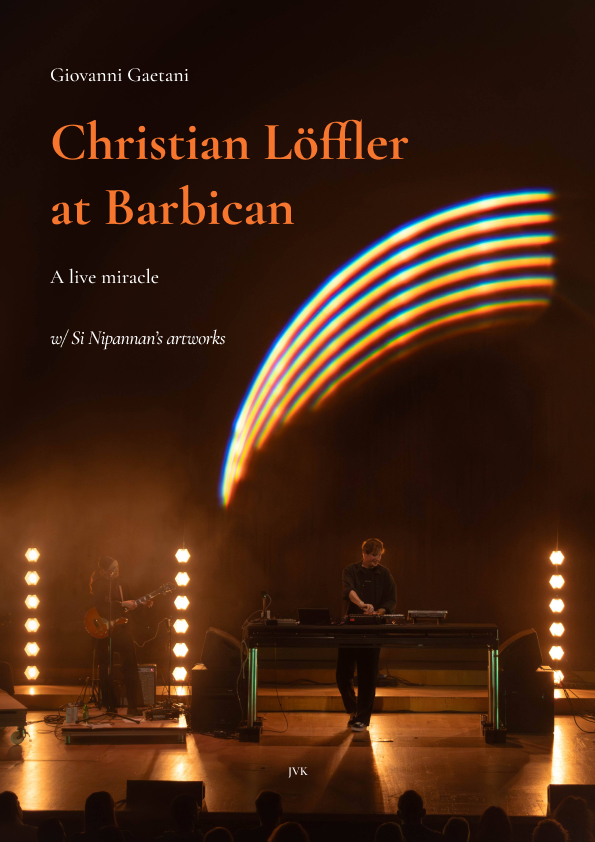
On Wednesday 11 February 2026, Christian Löffler brought his Until We Meet Again tour to the Barbican Centre in London.
Around two thousand people filled the Theatre Hall that night — spectators, artists, photographers, technicians, ushers, staff. All gathered in the same room. All breathing the same air. All watching the same miracle of presence unfolding before their eyes – and through their ears.
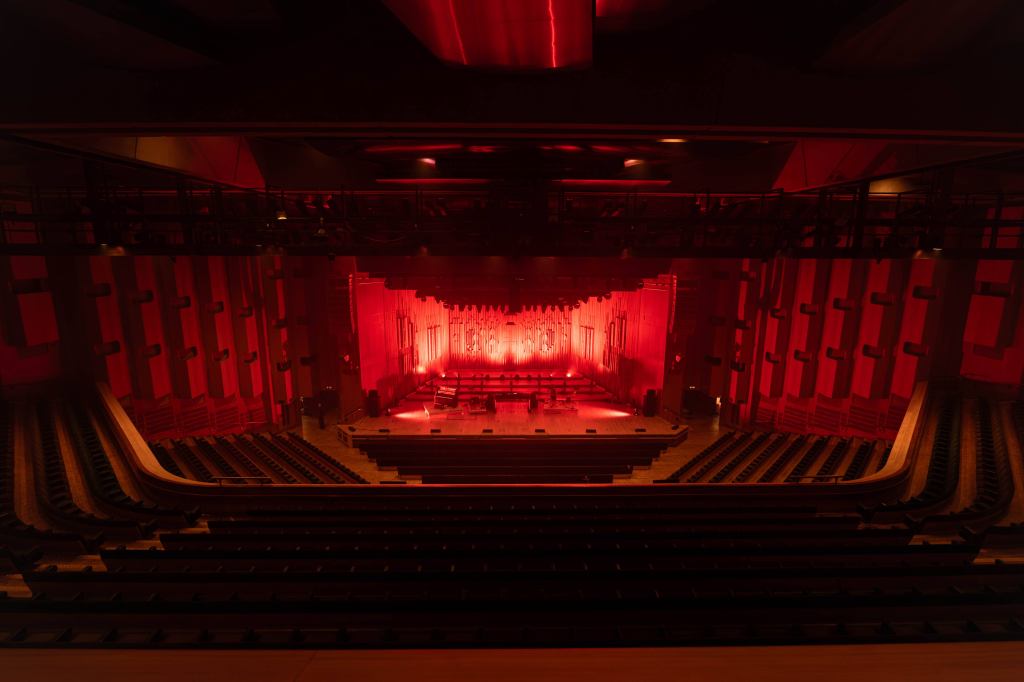
They witnessed something special. So special that the author of these pages felt compelled to go home and write a story about it.
These short pages are a semi-fictional account of that evening. They blend what truly happened with what never happened — and with what happened only in the souls of the people portrayed.
Only those who were there — in that room, at that exact moment, there and then — may be able to tell what is real and what belongs to imagination. But this is not really the point.
Art does not exist to be factual. It exists to be beautiful. To give us a reason to smile, a memory to hold, a tear to release.
For this reason, please read this book in the same spirit in which you would listen to an album — not questioning its authenticity, but simply allowing yourself to feel it, chapter after chapter, song after song.
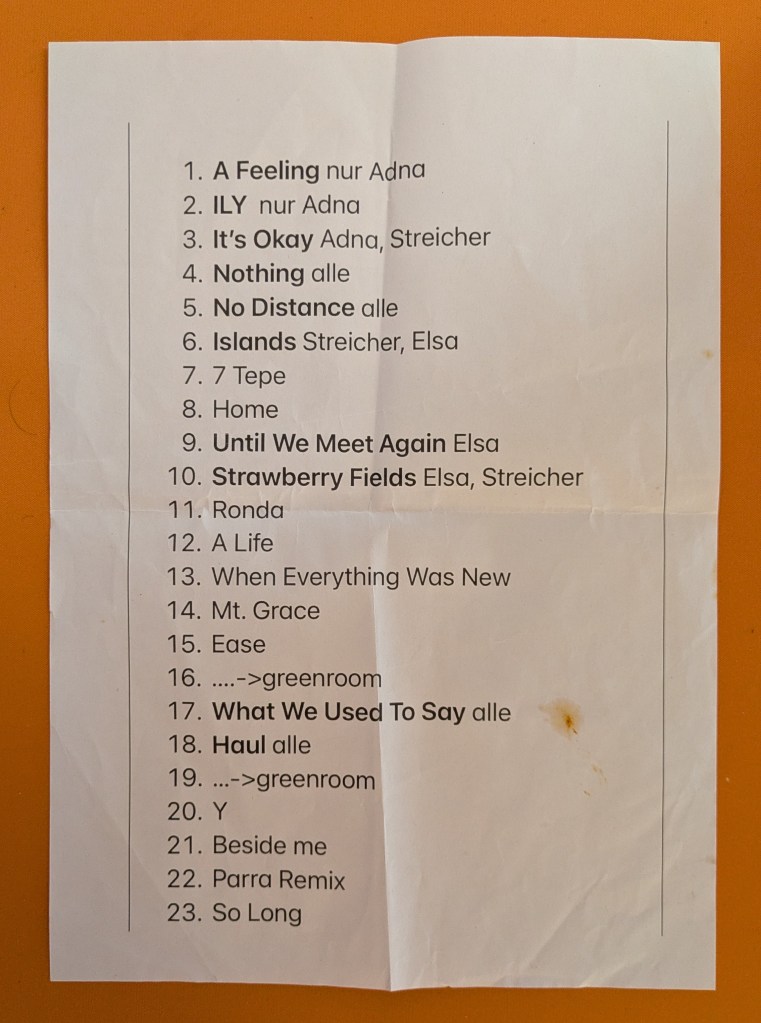
Each chapter corresponds to a song played that night, in exact order of execution. We recommend reading the book in one sitting, possibly from a laptop or a tablet to better enjoy Sisi’s artworks, while listening to the accompanying playlist.
This is your one-minute call. The lights are dimming. The doors of the theatre are about to close.
Take your seat. And enjoy the show.
8.00 pm – A Feeling
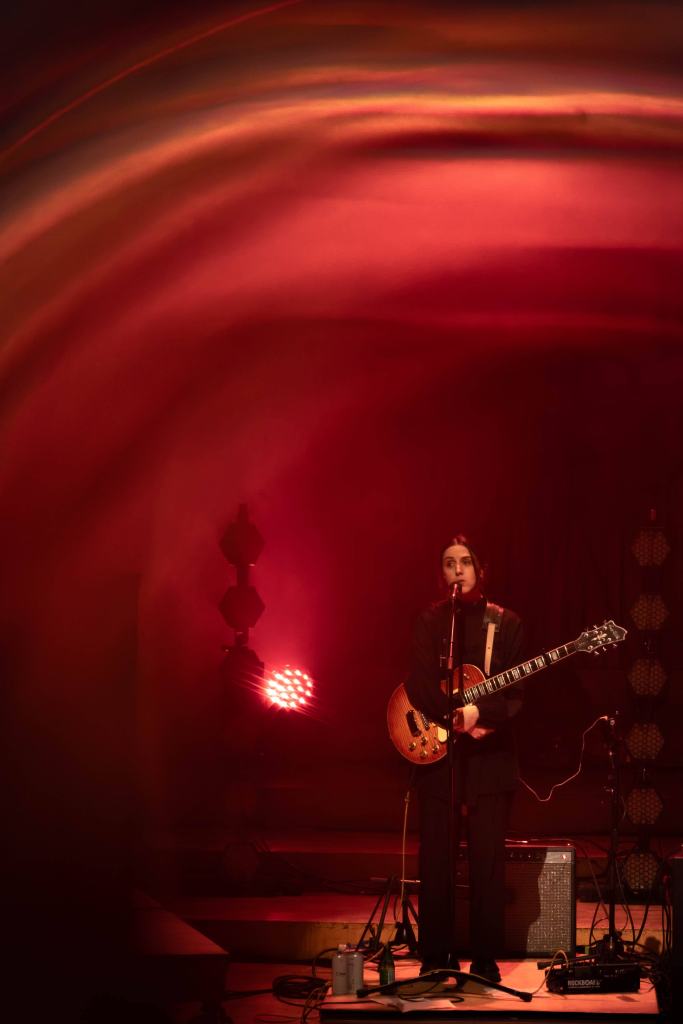
Joe looked to his left, sadly. There it was, the empty seat where his partner should have been. Adna had begun to sing from the stage. “It’s just a feeling, your hand on my forehead”. Her voice was distant yet steady. “I’d love it if we made it,” she continued. “And yet, not even this time Joseph and I made it”, Joe thought to himself, with a quiet ache.
His partner had to stay home, confined to bed. He had suffered an unexpected relapse of multiple sclerosis, the first in quite some time — three months. “You go,” his partner had said from the bed, “I wouldn’t want you to miss Christian at the Barbican for anything in the world.” It was not the first time this had happened; but perhaps this could have been the last, given his partner’s precarious circumstances.
Joseph was not doing well. His health was fragile. It was slowly deteriorating, week after week. The doctors said the situation needed close monitoring, yet they were hopeful he would recover, as he had miraculously done in the past.
His medical history resembled a rollercoaster. Joe’s mind drifted back to last July. On Friday 25, they had been dancing all day under the sun, on the grass at Junction 2, to the sound of Catching Flies, Parra for Cuva, Christian Löffler, Yotto, and Above & Beyond; then, two days later, on Sunday 27, they ended up in hospital for an emergency admission, after Joseph’s legs suddenly stopped responding, his breath grew short, and he needed intravenous steroids.
“Go, please, enjoy the evening for me.” Joe had heard that sentence so many times. He wanted to scream. To let the anger spill out — at the illness, at the timing, at how unfair life was. “Let’s get out of here,” Adna was singing on stage; Joe had felt the urge to shout those same words a few hours before, standing in front of Joseph’s bed: “Let’s get out of here, let’s go where the music is, where life unfolds, before it is too late”.
Instead, he had said nothing. He had looked into Joseph’s eyes with tenderness. Then kissed him on the forehead, said a heartbroken “I love you” and almost ran out of the room. Joe was holding back the flood behind his eyes. He waited until he had closed the door behind him. Only then he opened the dam, out of Joseph’s sight.
He did not want to be seen breaking – not by anyone, let alone by his weak, dying partner.
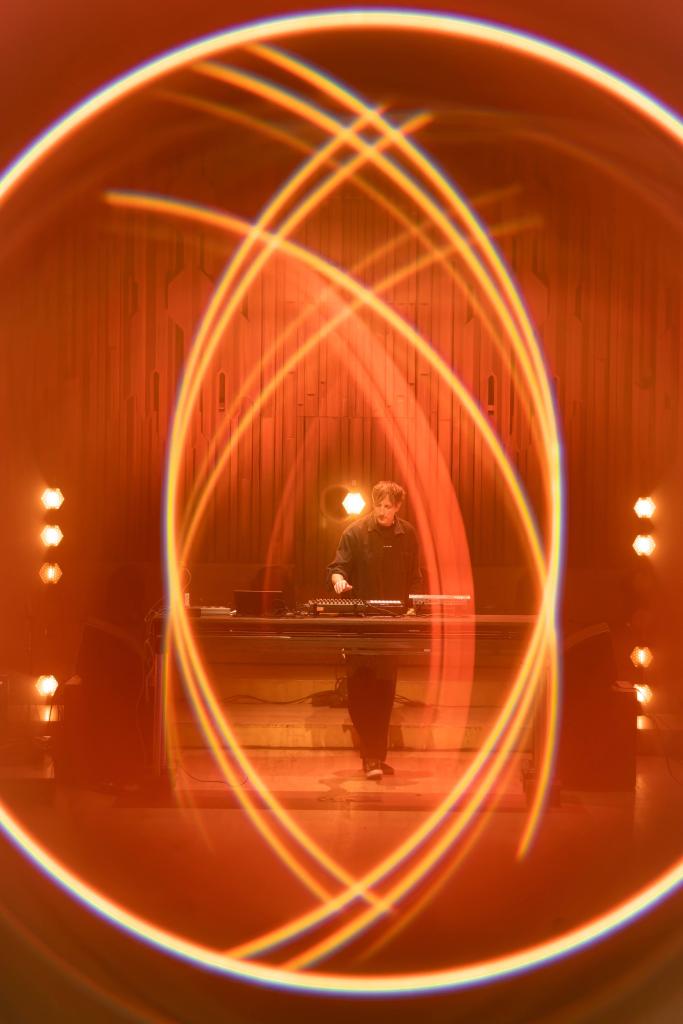
8.07 pm – ILY
Row U, seat 19. The Barbican seat was folded shut. It would have remained that way even if Joseph had been there. Those few cubic metres of empty air needed to contain not only his partner’s now 67 kilos — thinner and thinner from the medication draining him — but also, and above all, the nearly 100 kilos of his electric wheelchair. It was all red, like a Ferrari — but instead of the prancing horse, there was a big Anjunadeep logo.
Joe himself almost did not make it to the Barbican that evening. He had a ticket as Joseph’s carer. He would not have been allowed in without his disabled partner. He had to sort this out now, somehow.
Once he had stepped out of Joseph’s bedroom, Joe first wiped his tears, then immediately called the Barbican switchboard. It was already 6 pm. Explaining the situation was going to be hard, but he was used to those conversations by now. He cleared his throat. Then he chose, from his actor’s archive, that calm voice one uses when trying not to reveal they have just been crying.
A very kind woman answered, with a marked and unmistakable Greek accent. “My name is Cressida, how can I help you?” Joe explained that his disabled partner was not going to be able to attend, that there had been a relapse, that the ticket needed to be changed. She understood at once and amended the booking. In a classic burst of autistic extroversion, Joe asked with curiosity, “Ise ellinida?” — one of the few phrases he had learned from his Greek ex-fiancée, Selene, with whom he still shared the flat they had bought together three years earlier.
“Yes, I am Greek”, Cressida replied. “E tu sei italiano?”.
They both laughed at this polyglot exchange, not that rare between Londoners. Then Joe thanked her. “God bless immigrants!” he said, trying to forge a human connection with that faceless voice on the line.
“Yes, but only the good immigrants like us, not the others — the naughty ones,” she replied, leaving a faint bitterness behind in what, until that moment, had been a nice conversation, as sweet as a little pistachio baklava.
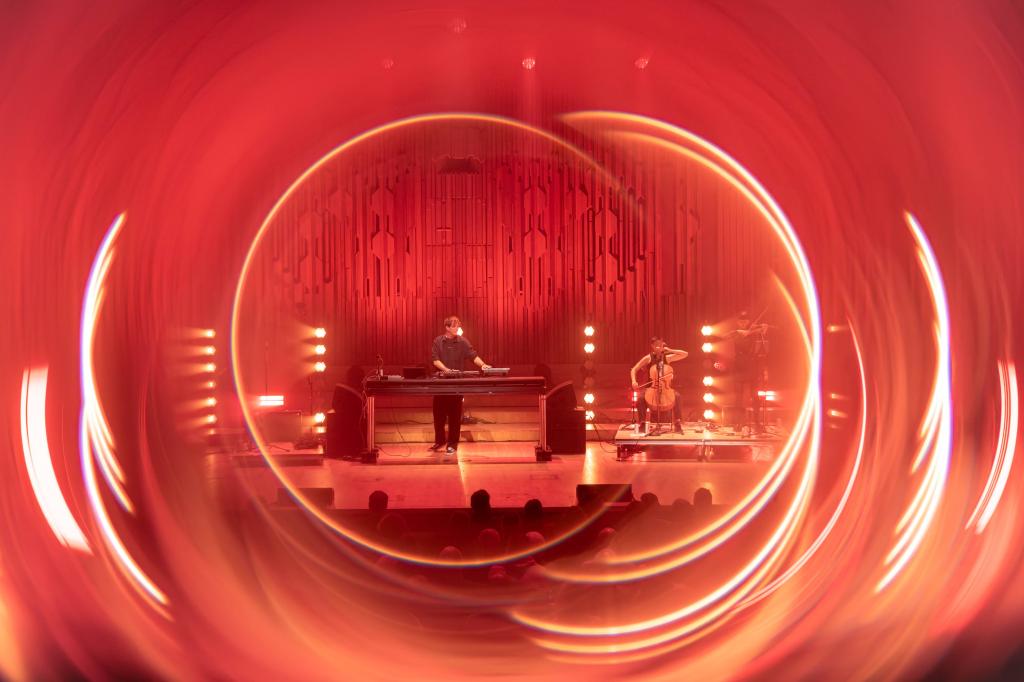
8.11 pm – It’s Okay
Red and orange lights warmed the beige wooden walls of the Barbican. Adna’s voice spread through the theatre, ethereal, like a treble voice in an abandoned Gothic cathedral. The insistent melody reminded Joe of the soprano line in the Miserere by Gregorio Allegri — that chorus rising so lightly, refining itself until it almost brushes silence. “But the Barbican is not a church. And Christian Löffler is not a priest,” Joe told himself, thinking of how Charles — his best friend and business partner — would have reacted to those semi-religious thoughts.
Charles was a hardcore atheist, a realist, an entrepreneur. Most importantly, he was the respectable face of their event: BHAN — raving with kindness. The moment Charles heard Joe using words like “ritual” or “spirituality” to talk about raves, he would burst into sarcastic laughter.
“Stop playing prophet on the dancefloor, Joe,” he would say in his older-brother voice. “You can’t preach our etiquette outside of BHAN, as if it were your gospel. You are not a prophet and BHAN is not a religion. Outside our events, everyone should be free to do whatever they want on the dancefloor — talk, check their phones, even spill drinks if they want, anything.”
Joe disagreed. For him, raves and concerts were moments of gathering. A ritual of communion — between people, artists, and music. Of course there was room for a few words of love or awe — “I love you so much”, “I adore this song”, “This moment is forever”. He even encouraged that kind of verbal interaction, because those were the words that mattered — the essential ones. But what about the pointless chit chat about yesterday’s work meeting or tomorrow’s family gathering? What about posting Instagram stories on the spot? Or wasting your time on WhatsApp messages that could have waited a few hours? That, he could not accept.
“When the music is playing, one must be present. One must be here and now,” Joe repeated like a mantra. He was trying to be there and then, at the Barbican. His eyes were closed, his ears open. He wanted to focus entirely on the music in order to disappear in it, but it was impossible in those circumstances. A couple in front of him was drinking beer and talking as if they were at the pub, completely ignoring the miraculous beauty of Adna’s voice.
“Be here and now.” That was Joe’s only message, the one he carried onto every dancefloor — his small, almost insignificant prophecy. He wore that invite at every rave, printed in orange letters on the back of his white vest. On the dancefloor, he truly danced like a madman, wearing lights and masks, writing signs and notes. Most people looked at him with confusion. A few understood what he was doing. And a couple of them would later show up at the next BHAN event. That was their marketing strategy. No flyers. No campaigns. Just showing up on London’s dancefloors, every week. Just being fully themselves at raves. And whoever resonated with their energy would then follow them.
Adna’s voice and Christian’s sound kept filling the hall. The couple in front of Joe had stopped talking. He was trying to lose himself in the music, but there was still an ache inside him, in his chest. An inner tightness he could not shake. He was not ready to let go. Not yet. And sitting on those foldable seats made it worse. He knew that to surrender to the music he would have to stand up from that seat – and dance.
Eleven minutes earlier, at exactly 8 pm, the Barbican ushers had closed the doors behind him. The show had started. “Let the journey begin,” he had written in his orange notebook, before the lights dimmed. He always took notes during concerts and raves. For him, being a writer was a 24/7 job. It did not only happen at his desk. It happened everywhere. All the time. He had to catch ideas the moment they appeared — like flies in the air — before they slipped away forever.
“Who’s inside is inside. Who’s outside is outside”, he concluded, writing by now in the darkness. In that instant he felt something he had not felt in years. It was like the start of a religious ritual. As A Feeling began, the opening notes sounded to him like the church bells of his childhood, announcing the start of the mass. For years he had taken part in that Sunday ritual with innocent joy. He was a child then. He grew up in a small town in southern Italy, bathed in sunlight 365 days a year. Now he was almost forty, living in London, soaked in rain 365 days a year. The orange damp umbrella he left under Joseph’s empty seat said it all.
Joe felt a sudden surge of sadness gather at the corners of his eyes. Like a mother, Adna kept reassuring him that it was just a feeling. Her voice reminded him of Ry X — that simple, devastating line from one of his favourite songs: “It’s only a feeling.”
Joe knew it was only a feeling. He also knew that it was okay to feel sad. And yet he could not shake the sadness away that night. He paused and thought about his life, a quiet despair swelling beneath the music, echoing Adna’s insistent chorus. He had just been fired for supporting Palestine. He had no idea how he would find work, now that a reference from his former employers was out of reach. His savings would last four months at best. He was living with his ex-fiancée, who no longer understood him. His partner was ill, and getting worse. What was he going to do with all of this?
“It’s okay, I’ll find a way,” he thought, sensing a microscopic glimmer of hope stirring inside him, as the song drifted toward its end.
“I still have myself. And that is enough. I’m alive. I’m here. You can let go now.”
Subscribe to keep reading
Dear Reader,
If you’re still here, it means something.
The story continues beyond this point.
There are still 22 chapters to go.
You can unlock the full text by making a small donation.
Your support makes this work possible.
Thank you,
Giovanni
 Giovanni Gaetani
Leave a comment